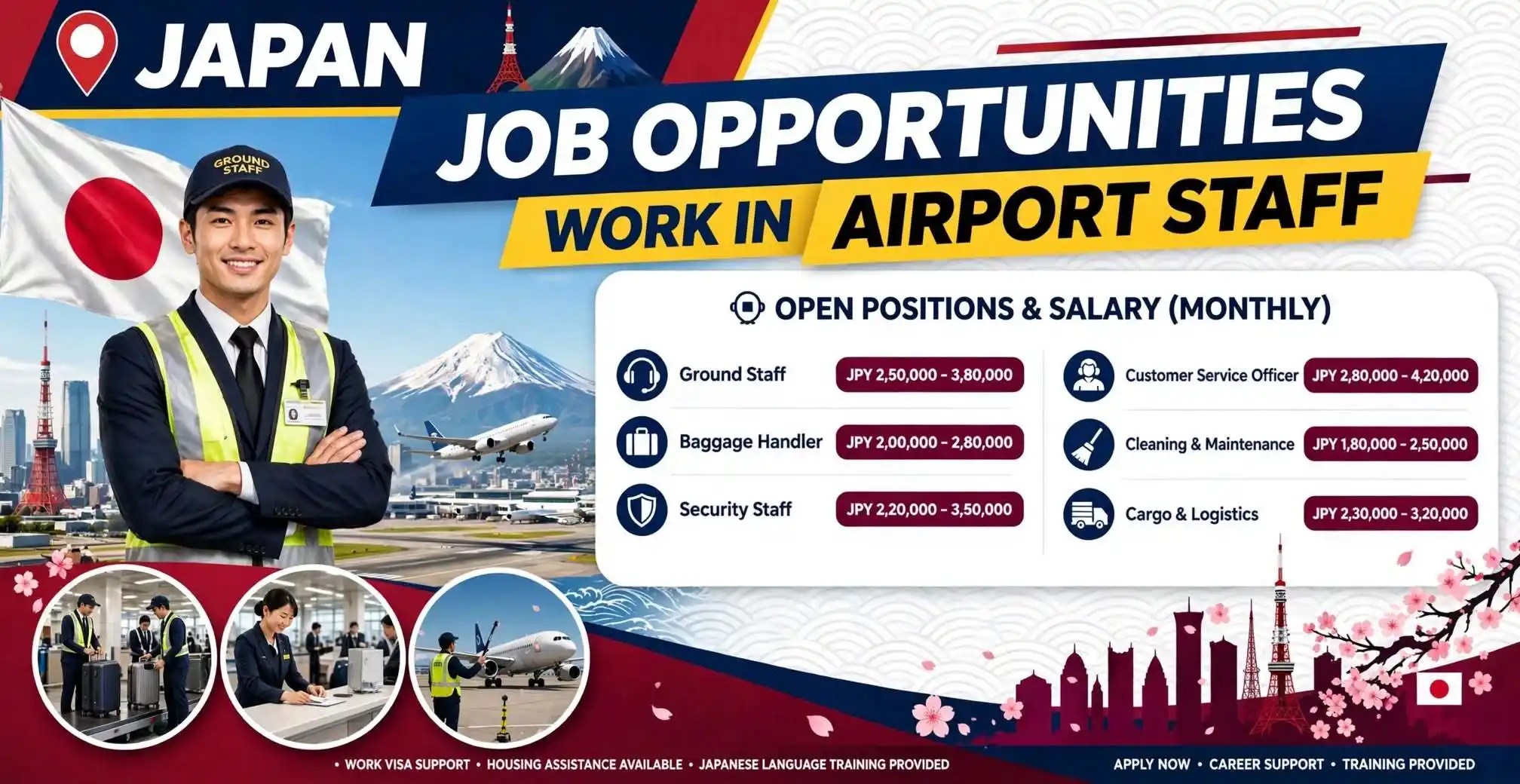
Japan’s airport and aviation industry offers employment opportunities across ground handling, baggage and cargo operations, aircraft support, passenger handling, cleaning and airport logistics. Japan’s official Specified Skilled Worker (SSW) system includes airport ground handling as an eligible aviation field, covering activities such as aircraft ground support, baggage and cargo handling, loading and unloading, cleaning, passenger handling, catering transport and aviation-fuel handling.
Japan’s aviation activity has also remained substantial. In fiscal 2025, Japanese airlines recorded about 112.5 million domestic passengers, while international passenger numbers operated by Japanese carriers reached about 23.46 million, according to Japan’s Ministry of Land, Infrastructure, Transport and Tourism.
This guide explains the major Japan airport work opportunities, common job roles, indicative salary ranges, eligibility, the SSW route, Japanese-language requirements, application steps and important precautions for Indian applicants.
Japan Airport Industry and Major Employment Areas
Japan has major international and domestic aviation hubs including:
- Tokyo Haneda Airport (HND)
- Narita International Airport (NRT)
- Kansai International Airport (KIX)
- Chubu Centrair International Airport (NGO)
- Fukuoka Airport (FUK)
- New Chitose Airport (CTS)
- Naha Airport (OKA)
Airport employment is not limited to airlines. Ground-handling companies, airport operators, cargo companies, cleaning contractors, catering businesses and logistics providers also support daily airport operations.
The aviation SSW framework specifically recognises airport ground handling as a field for foreign workers.
Main Airport Work Opportunities in Japan
1. Airport Ground Staff
Ground staff help coordinate airport operations before and after aircraft arrival and departure. Depending on the position, duties can include aircraft ground-support activities, baggage and cargo handling, loading and unloading and other turnaround operations.
2. Baggage Handler
Baggage staff sort, transport, load and unload passenger luggage. The work can involve lifting, outdoor operations and rotating or early-morning shifts.
3. Cargo & Warehouse Staff
Cargo employees handle freight moving through airport cargo facilities. Duties may include sorting, scanning, loading, unloading, warehouse operations and shipment preparation.
4. Aircraft Cleaning Staff
Aircraft cleaning teams prepare cabins between flights. Work can include cleaning seats, floors, lavatories and other aircraft interior areas according to strict turnaround schedules.
5. Passenger Handling Staff
Passenger-service roles can include assisting travellers, managing queues, providing information and supporting passengers who require assistance. These positions generally require stronger Japanese communication skills.
6. Catering & Meal-Handling Staff
Airport catering workers prepare, transport and load food and beverage equipment used for flights. The official SSW aviation framework includes transportation and loading/unloading of in-flight meals within ground-handling activities.
7. Ground Equipment Operator
Ground-support equipment is used around aircraft for baggage, cargo and aircraft servicing. Specific positions may require relevant training, licences or company qualifications.
8. Airport Security & Support Services
Security and other support work may exist at airports, but eligibility depends on the employer, job duties and applicable Japanese licensing or immigration requirements. Applicants should not assume every airport security position is covered by the aviation SSW category.
Japan Airport Jobs Salary Overview 2026
Salary varies significantly according to airport, employer, employment type, shift pattern, experience and overtime. The following figures should therefore be treated as indicative ranges rather than guaranteed Sagawa/airport salaries.
| Job Role | Indicative Monthly Salary (JPY) | Approx. INR* |
| Airport Helper / Ground Support | ¥180,000 – ¥250,000 | ₹1.08 – ₹1.50 lakh |
| Baggage Handler | ¥200,000 – ¥280,000 | ₹1.20 – ₹1.68 lakh |
| Cargo / Warehouse Staff | ¥200,000 – ¥300,000 | ₹1.20 – ₹1.80 lakh |
| Aircraft / Terminal Cleaning | ¥170,000 – ¥230,000 | ₹1.02 – ₹1.38 lakh |
| Catering Staff | ¥180,000 – ¥260,000 | ₹1.08 – ₹1.56 lakh |
| Ground Equipment Operator | ¥220,000 – ¥320,000 | ₹1.32 – ₹1.92 lakh |
| Passenger Service Staff | ¥190,000 – ¥270,000 | ₹1.14 – ₹1.62 lakh |
| Experienced Team Leader | ¥280,000 – ¥400,000 | ₹1.68 – ₹2.40 lakh |
*INR figures are approximate and depend on the exchange rate at the time of payment.
Night shifts, overtime, location allowances and other employer-specific payments can change actual monthly earnings.
Apply Now
What Does an Airport Ground-Handling Worker Do?
Airport ground handling is one of the clearest routes for foreign workers because it is explicitly included in Japan’s SSW aviation field.
According to Japan’s Immigration Services Agency, SSW airport ground-handling work can include:
- Aircraft ground movement support
- Baggage handling
- Cargo handling
- Loading and unloading baggage and cargo
- Aircraft interior and exterior cleaning
- Passenger handling
- Transportation and loading of in-flight meals
- Aviation-fuel handling
These activities are performed under the appropriate supervision and workplace qualifications.
Eligibility for Foreign Workers
Requirements depend on the exact position and immigration status.
For SSW aviation ground handling, the current official requirements include:
- Passing the Aviation Field Specified Skilled Worker evaluation test
- Japanese-language ability equivalent to JFT-Basic A2.2 or higher, or JLPT N4 or higher
- Meeting the relevant immigration requirements
- Obtaining an employment opportunity with an eligible accepting organisation
Japan’s official aviation SSW information confirms these skill and language requirements.
A previous qualification in an eligible Technical Intern Training pathway may provide exemptions in certain circumstances, subject to the applicable rules.
Japan SSW Aviation Visa Route
The Specified Skilled Worker (SSW) system provides a legal route for eligible foreign workers to work in designated industries.
For aviation, SSW covers two broad areas:
SSW (i):
- Airport ground handling
- Aircraft maintenance
SSW (ii):
- Higher-level airport ground-handling responsibilities
- Higher-level aircraft-maintenance work
The official SSW aviation framework states that SSW (i) airport ground handling has a total stay limit of up to five years, while SSW (ii) does not have the same overall upper stay limit and can provide a route for eligible workers to bring family members subject to the applicable requirements.
The current aviation framework also sets an SSW (i) intake ceiling of 4,900 workers through the end of March 2029.
Japanese Language Requirement
Japanese is an important part of airport employment because workers need to understand safety instructions, workplace procedures, schedules and communication from supervisors.
For the SSW aviation route, applicants generally need:
JFT-Basic A2.2 or higher
or
JLPT N4 or higher
as specified by Japan’s Immigration Services Agency.
For passenger-facing positions, practical Japanese ability can be particularly important even when a specific job has additional language requirements.
Education and Physical Requirements
Individual vacancies can set their own educational and experience requirements. There is no universal rule that every Japanese airport job requires exactly 10th or 12th pass, so applicants should check each vacancy rather than relying on a fixed age or education claim.
Ground-handling and baggage work can involve:
- Standing for long periods
- Lifting and moving luggage or cargo
- Working outdoors
- Working around aircraft and vehicles
- Early-morning or night shifts
- Following strict safety procedures
- Working under time-sensitive conditions
Applicants should honestly disclose relevant physical limitations and review the actual job description before accepting an offer.
Benefits and Working Conditions
Benefits depend on the employer and employment contract. Eligible employees may receive statutory Japanese insurance and employment protections.
Depending on the company, airport workers may also receive:
- Health insurance
- Employees’ pension
- Employment insurance
- Workers’ accident compensation
- Paid leave
- Overtime payments
- Shift allowances
- Commuting support
- Uniforms and training
- Company dormitory or housing assistance
Housing is not automatically guaranteed for every airport worker. If accommodation is advertised, applicants should confirm the rent, deposit, utilities, deductions and location in the written contract.
Major Airport Employment Areas
Tokyo Area
Haneda and Narita are major employment centres for passenger, baggage, cargo, cleaning and ground-handling services.
Osaka Area
Kansai International Airport is an important international gateway and supports passenger, cargo, ground-handling and airport-service employment.
Nagoya Area
Chubu Centrair provides opportunities connected with passenger services, baggage handling, cargo and aircraft ground operations.
Fukuoka Area
Fukuoka is an important aviation hub for western Japan and has a range of passenger and airport-support operations.
Sapporo and Okinawa
New Chitose and Naha are major regional airports supporting tourism, domestic travel, passenger handling and logistics activities.
How to Apply for Japan Airport Jobs From India
Step 1: Learn Japanese
Start preparing for JFT-Basic or JLPT N4 if you intend to use the SSW route.
Step 2: Choose Your Job
Decide whether you want:
- Ground handling
- Baggage handling
- Cargo
- Cleaning
- Catering
- Passenger services
- Equipment operation
Step 3: Check the SSW Requirements
Confirm that the exact job is eligible under the relevant SSW category and that you meet the skill and language requirements.
Step 4: Pass the Required Skill Test
The aviation field has an official SSW skills examination for airport ground handling. Japan’s Ministry of Land, Infrastructure, Transport and Tourism publishes the relevant examination information.
Step 5: Find an Eligible Employer
You need an appropriate employment relationship with an eligible accepting organisation. The aviation SSW framework places specific conditions on accepting organisations.
Step 6: Review the Employment Contract
Check:
- Basic salary
- Working hours
- Overtime
- Night-shift allowance
- Housing
- Deductions
- Insurance
- Holidays
- Job location
Step 7: Complete Immigration Procedures
The employer and applicant complete the required Certificate of Eligibility and visa procedures.
Step 8: Travel to Japan
After receiving the appropriate visa and completing the required procedures, travel to Japan, complete residence formalities and attend employer-provided training.
Important Scam Warnings
Airport jobs are sometimes advertised online with attractive salaries, airline logos and promises of guaranteed visas. Applicants should verify every offer carefully.
Be cautious if someone:
- Guarantees a specific airport job without an official recruitment process
- Promises a visa without meeting the required tests
- Demands a large cash payment for a guaranteed job
- Refuses to provide a written contract
- Uses an airport or airline logo without verifiable company details
- Claims that every airport job automatically comes with free accommodation and flights
Japan’s official SSW aviation system has defined skill, language and employer requirements. A recruiter cannot simply bypass those requirements.
Frequently Asked Questions
What airport jobs are available in Japan?
Common airport-related positions include ground handling, baggage and cargo handling, aircraft cleaning, passenger handling, catering support and other airport logistics roles.
Can Indians apply for airport jobs in Japan?
Yes, eligible Indian applicants can pursue Japanese employment through the applicable legal work-status route. For SSW aviation ground handling, applicants must satisfy the relevant Japanese-language and skill requirements.
Is Japanese language compulsory?
For the SSW aviation route, applicants need JFT-Basic A2.2 or higher or JLPT N4 or higher, subject to the applicable rules.
How much can airport workers earn?
There is no single fixed airport salary. Pay varies by employer, location, role, working hours and allowances. The salary figures above are indicative ranges rather than guaranteed wages.
Can I get an airport job without a driving licence?
Yes. Many airport roles, such as baggage handling, cargo handling, cleaning and some ground-support positions, do not involve driving. Specific equipment-driving jobs can have separate licence or qualification requirements.
Is accommodation provided?
Some employers may provide or arrange dormitory accommodation, but it is not universal. Always check the actual employment contract.
Can I directly get a Japanese airport visa by paying an agent?
No legitimate recruiter can sell a guaranteed visa. Immigration eligibility, required tests and employer sponsorship must be completed through the proper process.
Tips for Indian Applicants
Learn Japanese before applying rather than waiting until after receiving an offer. Keep your passport, education documents and test certificates ready, and verify the exact job category before paying any recruitment-related expenses.
For ground-handling positions, also prepare for physical work, shift schedules, safety procedures and working around aircraft and airport equipment.
Most importantly, verify the vacancy, employer, contract and immigration route before sending money to anyone.
Conclusion
Japan Airport Work Opportunities 2026 cover much more than passenger-service positions. Ground handling, baggage, cargo, cleaning, catering and other airport-support operations form an important part of Japan’s aviation workforce. Japan officially recognises airport ground handling under the SSW aviation field, with defined Japanese-language and skills requirements for eligible foreign workers.
For Indian applicants, the practical route is to learn Japanese, pass the required aviation skill examination, find an eligible employer, carefully review the employment contract and complete the official immigration process. Salary, accommodation and benefits should always be confirmed from the specific vacancy rather than assumed from online advertisements.
Disclaimer
This article is for general informational purposes only. It is not a job advertisement, recruitment notice or guarantee of employment and is not affiliated with any airline, airport operator or recruitment company. Salary figures are indicative and may vary by employer, location, working hours and allowances. Japanese immigration and SSW requirements can change, so applicants should verify the latest requirements through Japan’s Immigration Services Agency, the Ministry of Land, Infrastructure, Transport and Tourism and the relevant employer before taking action.

