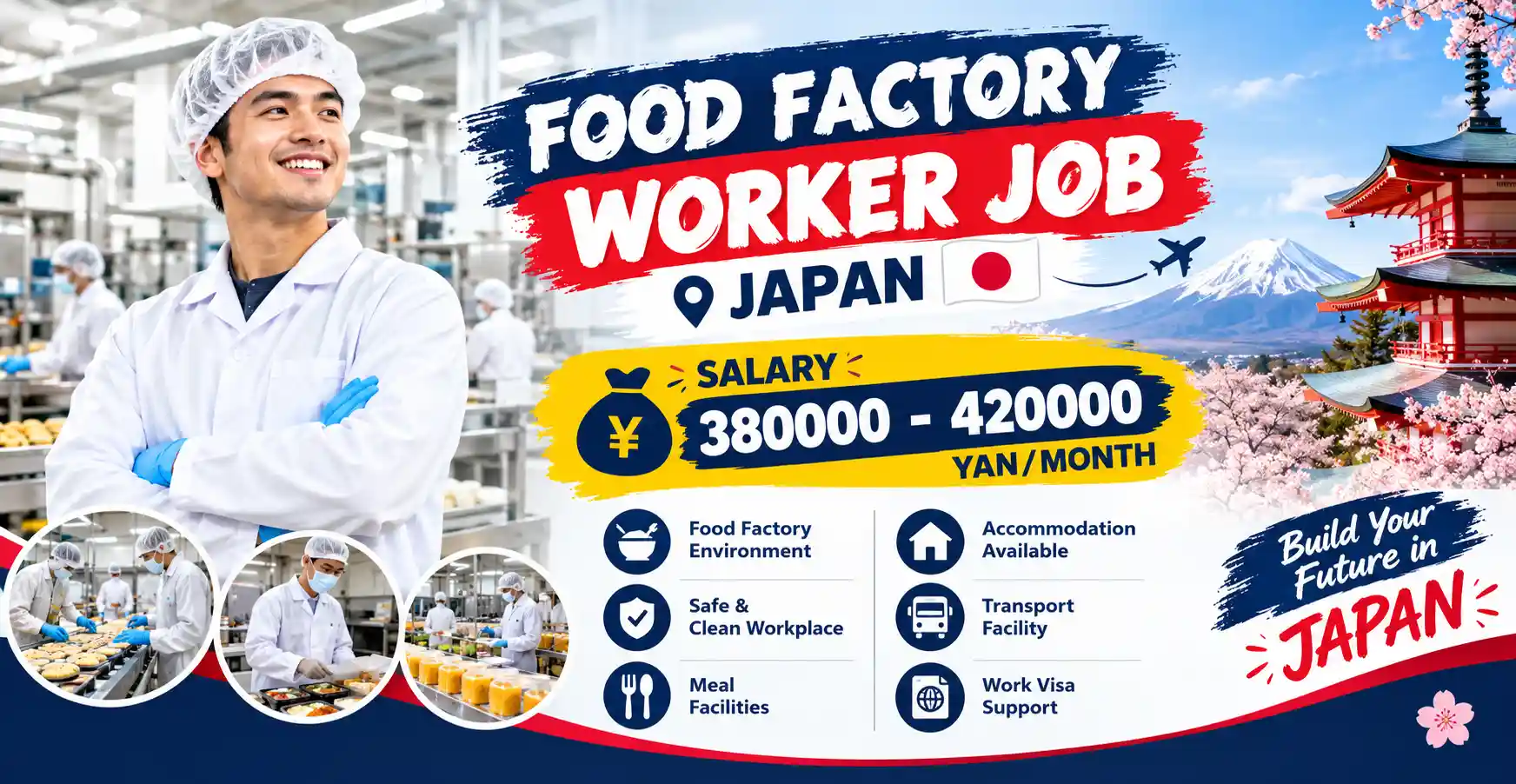
Japan’s food manufacturing industry provides employment across food processing, production, packaging, quality control, warehouse operations and hygiene-related work. Food factories supply supermarkets, convenience stores, restaurants, hotels and distribution networks throughout the country.
For foreign workers, food manufacturing is particularly relevant because Food and Beverage Manufacturing is an official Specified Skilled Worker (SSW) field. Japan’s Immigration Services Agency states that the field covers the manufacturing and processing of food and beverages, excluding alcoholic drinks, together with food safety and hygiene work.
As of September 2026, the official framework includes both SSW (i) and SSW (ii) routes for eligible food-manufacturing workers. The requirements differ between the two categories.
This guide explains the main Food Factory Worker Jobs in Japan, typical duties, salary considerations, Japanese-language requirements, SSW eligibility, working conditions, career growth and how overseas applicants can approach these opportunities safely.
Why Food Factory Workers Are Needed in Japan
Japan has a large and highly organised food-production industry. Food manufacturers supply products to:
- Supermarkets
- Convenience stores
- Restaurants
- Hotels
- Schools and institutions
- Food-service companies
- Wholesale distributors
- Export markets
The industry includes factories producing bread, prepared meals, meat products, seafood, beverages, noodles, frozen foods, confectionery and many other products.
Japan’s Ministry of Agriculture, Forestry and Fisheries continues to operate programmes supporting the appropriate acceptance and employment of foreign workers in food and beverage manufacturing, reflecting the industry’s workforce needs.
What Does a Food Factory Worker Do?
The exact work depends on the factory and production line.
Typical duties can include:
- Preparing raw ingredients
- Sorting food materials
- Cutting and portioning
- Mixing ingredients
- Cooking or heating
- Processing food
- Operating production equipment
- Packing finished products
- Labelling products
- Checking weights and packaging
- Inspecting product quality
- Cleaning machinery and work areas
- Maintaining hygiene standards
- Preparing products for shipment
Japan’s official SSW description specifically covers food and beverage manufacturing and processing as well as maintaining safety and hygiene.
Main Food Factory Jobs in Japan
Food Production Worker
Production workers support the manufacturing process from raw materials through finished products.
Responsibilities can include preparing ingredients, operating machinery, monitoring production and removing completed products from the production line.
Food Packing Worker
Packing employees prepare finished products for distribution.
Typical tasks include:
- Filling trays
- Sealing packages
- Applying labels
- Checking dates
- Inspecting packaging
- Packing cartons
- Preparing products for dispatch
Accuracy is important because food products must be correctly packaged and identified.
Food Processing Worker
Processing jobs can involve cutting, mixing, heating, sterilisation, forming, freezing or drying depending on the product.
These activities fall within the official food-manufacturing SSW field.
Bakery Factory Worker
Commercial bakeries produce bread, cakes, pastries and other products at high volume.
Workers may assist with:
- Dough preparation
- Ingredient measurement
- Baking
- Cooling
- Decoration
- Packaging
- Cleaning
Some bakeries operate overnight so products can be delivered to stores early in the morning.
Bento and Prepared-Meal Worker
Prepared-meal factories produce boxed meals and ready-to-eat food.
Employees may work on:
- Ingredient preparation
- Cooking
- Rice preparation
- Portioning
- Meal assembly
- Packaging
- Labelling
- Final inspection
Frozen Food Worker
Frozen-food factories process and package products for supermarkets and food-service businesses.
Depending on the facility, workers may handle:
- Food preparation
- Processing
- Freezing
- Packaging
- Temperature checks
- Cold-storage operations
Some positions require employees to work in low-temperature areas.
Meat Processing Worker
Meat-processing facilities may employ workers for:
- Cutting
- Portioning
- Processing
- Weighing
- Packaging
- Labelling
- Cleaning
Strict hygiene and safety procedures are an essential part of this work.
Seafood Processing Worker
Seafood factories can involve:
- Sorting
- Cleaning
- Cutting
- Processing
- Freezing
- Packaging
- Quality inspection
Some positions involve wet or cold working environments.
Beverage Factory Worker
Beverage manufacturing facilities may employ workers in:
- Filling
- Bottling
- Packaging
- Labelling
- Machine operation
- Inspection
- Warehouse support
Large facilities often use automated production and packaging equipment.
Quality-Control Worker
Quality-control employees check whether products meet factory standards.
Their responsibilities can include:
- Visual inspections
- Weight checks
- Packaging checks
- Temperature monitoring
- Hygiene checks
- Recording defects
- Following food-safety procedures
Quality-control experience can provide a pathway toward more responsible positions within manufacturing.
Food Factory Salary in Japan
There is no single nationwide salary for food factory workers. Pay varies according to employer, prefecture, employment type, experience, shift pattern, overtime and allowances.
For a website guide, the following can be presented as indicative ranges rather than guaranteed wages:
| Job Role | Indicative Monthly Salary |
| Entry-Level Food Factory Worker | ¥200,000 – ¥240,000 |
| Food Production Worker | ¥210,000 – ¥260,000 |
| Food Packing Worker | ¥200,000 – ¥250,000 |
| Food Processing Worker | ¥210,000 – ¥270,000 |
| Bakery Factory Worker | ¥210,000 – ¥260,000 |
| Bento / Prepared Meal Worker | ¥210,000 – ¥270,000 |
| Frozen Food Worker | ¥220,000 – ¥280,000 |
| Quality-Control Worker | ¥230,000 – ¥300,000 |
| Experienced Production Worker | ¥250,000 – ¥320,000+ |
| Production Team Leader | ¥280,000 – ¥380,000+ |
Actual salaries should always be confirmed from the individual job offer and employment contract.
Apply Now
What Can Increase Monthly Earnings?
Several factors can affect actual earnings.
Night Work
Factories producing fresh meals, bakery products and convenience-store food may operate overnight. Applicable late-night premiums can increase pay.
Overtime
Additional working hours may increase monthly earnings when overtime is available and legally compensated.
Experience
Workers who can perform multiple production tasks may have access to more responsibilities.
Machine Operation
Learning to operate production and packaging machinery can support progression into more skilled roles.
Quality Control
Experience with food-safety and inspection procedures can support career development.
Supervisory Responsibilities
Experienced workers who coordinate production teams may receive higher compensation.
Working Shifts in Japanese Food Factories
Food manufacturing does not always follow normal daytime office hours.
Possible schedules include:
- Morning shifts
- Day shifts
- Evening shifts
- Night shifts
- Rotating shifts
- Weekend shifts
- Holiday shifts
Fresh-food factories can have particularly early or late schedules because products must reach retailers according to delivery deadlines.
Applicants should confirm the exact shift pattern before signing a contract.
Working Environment
Food factories are generally structured and process-driven workplaces.
Employees may be required to:
- Wear uniforms
- Use hair coverings
- Wear masks or gloves where required
- Wash and sanitise hands
- Follow contamination-control procedures
- Maintain clean work areas
- Follow machinery-safety rules
- Meet production schedules
Some factories can be cold, hot, noisy or physically demanding depending on the production process.
Japanese Language Requirements
Japanese language ability is important even when the job does not involve direct customer service.
Workers need to understand:
- Safety instructions
- Hygiene rules
- Production procedures
- Supervisor instructions
- Work schedules
- Equipment warnings
- Workplace communication
For SSW (i) food and beverage manufacturing, the official requirement includes either the JFT-Basic at A2.2-equivalent level or JLPT N4 or higher, alongside the required skills evaluation.
Food Manufacturing and the SSW Route
Food and beverage manufacturing is officially included in Japan’s Specified Skilled Worker system.
Under the current official framework:
SSW (i)
Workers need:
- Food and Beverage Manufacturing SSW evaluation test
- JFT-Basic A2.2-equivalent Japanese or JLPT N4+
- The required immigration and employment conditions
Workers who have successfully completed certain qualifying Technical Intern Training pathways may receive applicable test exemptions under the rules.
SSW (ii)
The higher-level route requires the relevant SSW (ii) skills examination and practical experience involving work management and supervising multiple employees.
The official framework is being updated as Japan develops its foreign-worker systems, so applicants should check the latest requirements before applying.
Food Manufacturing Skill Test
Applicants using the SSW route need to satisfy the applicable food-manufacturing skills requirement.
Japan’s Ministry of Agriculture, Forestry and Fisheries identifies the OTAFF organisation as the examination body for the food and beverage manufacturing SSW skills tests. It also provides study materials for candidates preparing for the examination.
This means applicants should prepare for the official examination rather than relying only on a recruitment agent’s training certificate.
Can Indians Apply for Food Factory Jobs in Japan?
Eligible Indian workers can pursue Japanese employment through the appropriate immigration route if they satisfy the requirements for the job and residence status.
For the SSW food-manufacturing route, the applicant must meet the applicable:
- Japanese-language requirement
- Skills-test requirement
- Employment requirements
- Immigration requirements
The employer must also satisfy the relevant conditions for accepting SSW workers. The food-industry SSW council requires eligible accepting organisations to become members and cooperate with the council.
Career Growth in Food Manufacturing
Food-factory work can become a longer-term career rather than remaining an entry-level position.
A possible progression is:
Factory Worker → Skilled Production Worker → Machine Operator → Senior Operator → Team Leader → Production Supervisor
Another route is:
Production Worker → Quality Inspector → Quality Coordinator → Quality Supervisor
Warehouse-oriented workers can also progress toward:
Warehouse Worker → Inventory Coordinator → Warehouse Team Leader → Logistics Supervisor
Actual promotion depends on the employer, performance, qualifications and available positions.
Technology in Modern Food Factories
Modern Japanese food factories increasingly combine human workers with automated equipment.
Employees may work with:
- Conveyor systems
- Automated packaging machines
- Barcode scanners
- Weighing equipment
- Temperature-monitoring systems
- Production-control systems
- Inventory software
- Warehouse-management systems
Learning these systems can help workers develop technical skills beyond basic manual production.
Food Factory Warehouse Work
Many factories have their own storage and dispatch areas.
Warehouse employees may:
- Receive raw materials
- Check stock
- Move products
- Prepare orders
- Manage cold storage
- Scan products
- Prepare shipments
- Maintain inventory records
Experience in both manufacturing and warehouse operations can be useful for future logistics positions.
Accommodation and Living Arrangements
Some employers may offer company dormitories or housing support, but accommodation is not automatically included with every food-factory job.
Applicants should confirm:
- Monthly rent
- Deposit
- Utility charges
- Transportation
- Distance from factory
- Furniture
- Shared/private room arrangements
- Deductions from salary
A lower-cost dormitory can reduce monthly living expenses, but the exact terms should always be written in the employment agreement.
Health Insurance and Employee Benefits
Eligible workers can participate in Japan’s statutory social-insurance systems according to their employment conditions.
Depending on the position, employment arrangements can involve:
- Health insurance
- Employees’ pension
- Employment insurance
- Workers’ accident compensation
- Paid leave
Additional benefits vary by employer and may include commuting allowances, housing support, uniforms, meals or bonuses.
Banking and Salary Management
Workers moving to Japan should understand their monthly payslip rather than looking only at the advertised gross salary.
Deductions can include:
- Income tax
- Resident tax where applicable
- Health insurance
- Pension
- Employment insurance
- Housing or other contractual deductions
A useful approach is to divide monthly income between:
Living expenses + Emergency savings + Family remittances + Career training + Long-term savings
This makes it easier to manage income consistently.
Personal Loans and Financial Planning
A stable employment history can sometimes help when applying for financial products, but loan approval is determined by individual lenders.
Before taking a personal loan, compare:
- Interest rate
- Processing fees
- Monthly repayment
- Total repayment
- Loan duration
- Early-repayment terms
Workers should avoid taking large loans based solely on expected overtime because overtime can vary from month to month.
Real Estate and Home Loans
Foreign workers who establish stable employment in Japan may eventually consider purchasing property, subject to lender and immigration requirements.
A home purchase involves more than the monthly mortgage:
- Down payment
- Interest
- Property tax
- Insurance
- Maintenance
- Repairs
- Management fees where applicable
A stable income history can be useful when applying for financial products, but mortgage approval is never guaranteed.
How to Apply for Food Factory Jobs in Japan
Step 1: Learn Japanese
Prepare for JFT-Basic or JLPT N4 if you plan to use the SSW route.
Step 2: Choose Your Job Type
Decide whether you prefer:
- Production
- Packing
- Processing
- Bakery
- Bento production
- Frozen food
- Meat processing
- Seafood processing
- Quality control
- Warehouse work
Step 3: Prepare for the Skills Test
Study the official food-manufacturing materials and check current OTAFF examination information.
Step 4: Find an Eligible Employer
Check whether the employer is able to hire workers under the relevant immigration category.
Step 5: Check the Employment Contract
Confirm:
- Salary
- Working hours
- Overtime
- Shift allowance
- Holidays
- Housing
- Insurance
- Deductions
- Workplace location
Step 6: Complete Immigration Procedures
The employer and worker complete the required procedures for the relevant residence status.
Step 7: Travel and Begin Training
After receiving the required permission and visa, the worker can travel to Japan and complete the employer’s workplace orientation and training.
How to Avoid Fake Food Factory Job Offers
Applicants should be careful with online recruitment advertisements.
Be suspicious if someone promises:
- Guaranteed Japan visa
- Guaranteed factory job
- Extremely high salary without conditions
- Free accommodation with no written details
- Employment without an interview
- A visa without the required tests
- A job offer only after a large cash payment
The official SSW process has defined skill, language and employer requirements. A private agent cannot simply remove those requirements.
Frequently Asked Questions
What does a food factory worker do in Japan?
Food factory workers can prepare ingredients, process products, operate machinery, package food, inspect products and maintain hygiene and safety standards.
What is the salary for food factory workers in Japan?
Salary varies by employer and location. Indicative entry-level ranges can be around ¥200,000–¥240,000 per month, while experienced or supervisory roles may pay more.
Can Indians get food factory jobs in Japan?
Eligible Indian workers can apply through the appropriate Japanese employment and immigration routes. The SSW food-manufacturing field has specific language and skills requirements.
Is Japanese language required?
For SSW (i) food and beverage manufacturing, applicants generally need JFT-Basic A2.2-equivalent or JLPT N4 or higher, subject to the applicable rules and exemptions.
Is a skills test required?
Yes, SSW (i) applicants generally need to pass the Food and Beverage Manufacturing SSW evaluation test unless an applicable exemption applies.
Do food factories provide accommodation?
Some employers may provide dormitories or housing assistance, but it is not universal. Check the actual employment contract.
Are night shifts available?
Yes. Food factories producing fresh meals, bakery products and other time-sensitive products may operate night or rotating shifts.
Can a food factory worker become a supervisor?
Career progression is possible. Experience in production, machinery, quality control, hygiene and team coordination can support movement into higher-responsibility positions.
Conclusion
Food Factory Worker Jobs in Japan 2026 cover a wide range of opportunities, from production and packaging to food processing, bakery work, frozen-food manufacturing, quality control and warehouse operations.
For foreign applicants, Japan’s Specified Skilled Worker food and beverage manufacturing field provides a formal route for eligible workers. The current framework requires the appropriate skills qualification and Japanese-language ability for SSW (i), while SSW (ii) has higher skills and practical management requirements.
For someone planning a career in Japan, the most useful preparation is to learn Japanese, understand the food-manufacturing skills test, verify the employer, check the complete employment contract and use the official immigration process.
Food-factory work can also provide a foundation for longer-term development into machine operation, quality control, warehouse management and production supervision.
Disclaimer
This article is for general informational purposes only. It is not an official recruitment notice, job guarantee or immigration service, and it is not affiliated with any Japanese food company or recruitment agency. Salary figures are indicative and may vary according to employer, location, shift pattern, overtime and experience. Japanese immigration and SSW rules can change, so applicants should verify current requirements with Japan’s Immigration Services Agency, the Ministry of Agriculture, Forestry and Fisheries and the relevant examination body before taking action. Never pay an unverified person for a guaranteed job or visa.

