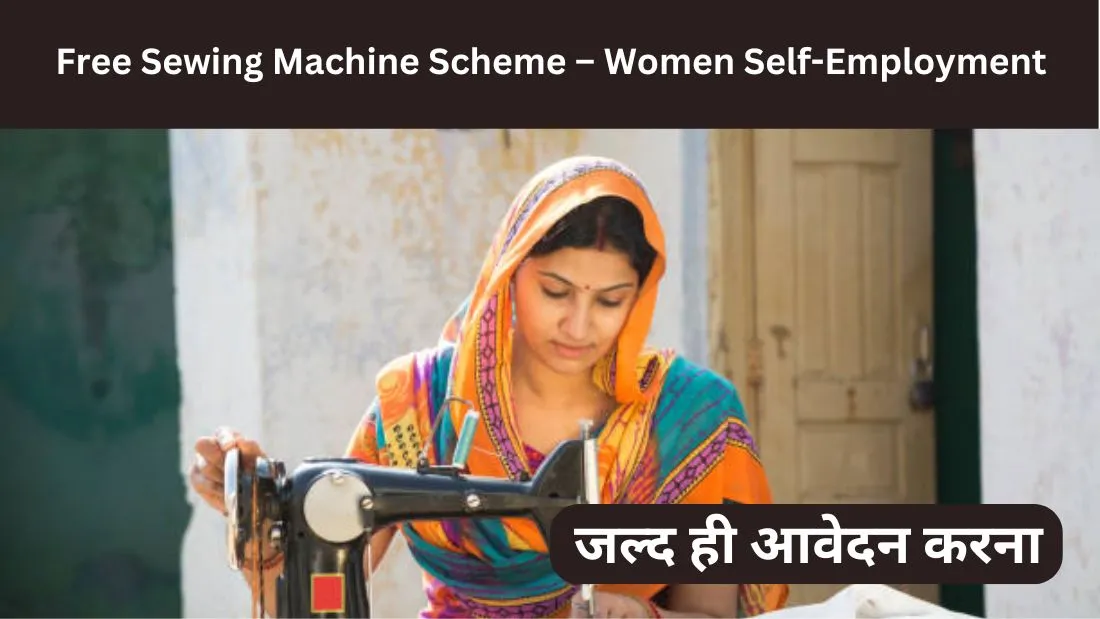
The Free Sewing Machine Scheme is an important initiative introduced to support women from economically weaker sections of society. The primary aim of this program is to provide eligible women with sewing machines so they can start tailoring work and earn a stable income from home.
This scheme focuses on promoting self-employment and helping women become financially independent. By enabling women to generate income through tailoring and garment-making, the program contributes to poverty reduction and strengthens families at the grassroots level.
Objectives of the Free Sewing Machine Scheme
The scheme is designed not only to provide financial assistance but also to encourage self-reliance and entrepreneurship among women. It plays a significant role in empowering women and promoting gender equality.
Key objectives include:
- Creating self-employment opportunities for women
- Supporting women from low-income families
- Improving the financial stability of households
- Encouraging women to become self-sufficient
- Promoting skill development in rural and semi-urban areas
- Reducing economic dependence on others
By providing sewing machines, women can start home-based tailoring businesses or work with garment production units.
Eligibility Criteria
To ensure the benefits reach deserving candidates, certain eligibility conditions are set:
- Applicant must be a woman and a resident of India
- Age should be between 20 and 40 years
- Annual family income must be below ₹1,20,000
- Widows and differently-abled women receive special preference
- Basic knowledge of tailoring is preferred, or willingness to undergo training
Documents Required
Applicants need to submit the following documents:
- Aadhaar Card (identity and address proof)
- Income Certificate
- Age Proof (Birth Certificate, 10th Certificate, etc.)
- Residence Certificate
- Caste Certificate (if applicable)
- Passport-sized photographs
- Mobile number linked with Aadhaar
How to Apply
Women can apply through either offline or online methods depending on availability in their region.
Apply Here :
Offline Application Process
- Visit the nearest District Social Welfare Office or Women and Child Development Department.
- Request the application form for the Free Sewing Machine Scheme.
- Fill in accurate personal, income, and address details.
- Attach all required documents.
- Submit the completed form to the concerned officer.
- After verification, applicants will be informed about approval and machine distribution.
Online Application Process
In some states, online applications are available. The general process includes:
- Visit the official government portal of your state.
- Search for the Free Sewing Machine Scheme under welfare schemes.
- Register using your Aadhaar-linked mobile number.
- Fill in all required details carefully.
- Upload scanned copies of necessary documents.
- Submit the application and keep the acknowledgment receipt.
- Status updates are provided through SMS or email.
Helpline and Assistance
For assistance:
- Contact the official toll-free helpline number provided by your state government.
- Visit your local Gram Panchayat office or Block Development Office.
- Approach the Women and Child Development Department for guidance.
Tips to Avoid Common Mistakes
- Double-check all information before submission.
- Ensure Aadhaar details are accurate and updated.
- Upload clear document copies.
- Keep a copy of your application and acknowledgment receipt.
Benefits of the Scheme
The scheme provides several direct and indirect advantages:
- Immediate income generation opportunity
- Increased confidence and dignity
- Reduced financial dependency
- Encouragement for small-scale entrepreneurship
- Greater participation of women in the workforce
- Support for rural economic development
Implementation Across States
Different states implement the scheme with slight modifications to suit local needs:
- Tamil Nadu distributes machines through Panchayats and Self-Help Groups.
- Gujarat organizes special camps in tribal areas.
- Maharashtra offers vocational training along with machine distribution.
- Uttar Pradesh prioritizes widows and women from backward classes.
These variations enhance the effectiveness of the scheme at the regional level.
Challenges and Limitations
Despite its benefits, the scheme faces certain issues:
- Lack of awareness in remote regions
- Delays in processing and distribution
- Limited follow-up training or marketing support
- Concerns regarding machine quality and maintenance
Addressing these challenges can improve long-term impact.
Suggestions for Improvement
The scheme can be strengthened through:
- Awareness campaigns in regional languages
- Collaboration with NGOs and Self-Help Groups
- Certification programs after skill training
- Providing starter toolkits and materials
- Creating online platforms for rural women entrepreneurs
Success Stories
Many women have improved their financial condition through this initiative. For example, a beneficiary from Madhya Pradesh started her own tailoring shop and now earns a stable monthly income while training other women.
Similarly, a woman from Tamil Nadu began stitching school uniforms and now supplies to multiple schools, generating employment for others in her community.
Frequently Asked Questions (FAQ)
- Who is eligible for the Free Sewing Machine Scheme?
- Is the scheme available in all states?
- Is there any application fee?
- What documents are required?
- How can I check application status?
- Can men apply under this scheme?
- What happens if the application is rejected?
- Is training provided?
- Can someone apply on behalf of a family member?
- How long does approval and distribution take?
Conclusion
The Free Sewing Machine Scheme is a meaningful step toward empowering women and promoting self-employment. It not only provides equipment but also creates opportunities for financial independence and social upliftment.
With better awareness, efficient implementation, and proper training support, the scheme has the potential to transform the lives of millions of women. By encouraging women to become income earners and entrepreneurs, it contributes significantly to building a self-reliant and economically strong nation.

